

Blog
Crohn’s Disease vs. Ulcerative Colitis
What is Ulcerative Colitis?
Nicholas Kruzdlo
Physician Reviewed

They share a name, and both fall under Irritable Bowel Disease (IBD), but Crohn’s disease and ulcerative colitis are two distinct conditions. Here’s what sets them apart, and where Crohn’s colitis fits into the picture.
When people hear inflammatory bowel disease (IBD) or even inflammatory bowel syndrome (IBS), they often think these are all names for a single condition. They all mean very different things. Understanding your symptoms and how each is diagnosed is essential to pursuing the proper treatment.
Irritable Bowel Syndrome (IBS) vs Irritable Bowel Disease (IBD)
We must first set aside IBS, as it is something completely different from IBD, which includes both Crohn's disease and ulcerative colitis. While people suffering from IBS may experience similar symptoms like abdominal pain, cramping, bloating, and changes in bowel habits,the critical distinction lies beneath the surface.
IBS is a functional disorder, meaning the gut isn't communicating or moving the way it should, but there is no underlying inflammation, no tissue damage, and no structural abnormalities.
IBD, by contrast, causes real, measurable damage to the lining of the GI tract. Damage that can be seen on a colonoscopy, confirmed under a microscope, and that worsens over time without proper treatment.
What is Inflammatory Bowel Disease?
Inflammatory Bowel Disease is a category of chronic, immune mediated conditions characterized by inflammation of the gastrointestinal tract (GI). The immune system, which normally protects the body from infection becomes confused. Instead of attacking things it should,like viruses and bacteria. It starts to attack the lining of the gut. This causes extensive tissue damage that without management can be relentless and progressive.
3M Americans living with IBD | ~10% of IBD cases are indeterminate | 20s–30s most common age of onset |
Where the Inflammation Lives: Crohn’s versus Ulcerative Colitis
The most fundamental difference between Crohn’s disease and ulcerative colitis is anatomical: where in the GI tract inflammation occurs.
Crohn’s Disease
Crohn’s disease can affect any segment of the gastrointestinal tract, from the mouth all the way to the anus.
It most commonly targets the final stretch of the small intestine and the beginning of the large intestine (colon). Up to 25% of patients, can also develop inflammation around the anal area. These are called fistulas and abscesses.
One of Crohn’s defining features is its patchy nature. Discontinues sections of inflammation will line the gastrointestinal tract. Diseased segments of the bowel are mixed in with stretches of healthy tissue. This pattern is called skip lesions. This patchy diseased tissue is a key difference between Crohn’s disease and ulcerative colitis and something physicians look for during diagnostic colonoscopies.
Ulcerative Colitis
Ulcerative colitis, in contrast, is only present in the large intestine, also known as the colon and rectum.
It will never affect the small intestine, stomach, or upper GI structures. The other major difference is that unlike Crohns, Ulcerative Colitis will cause continuous uninterrupted inflammation all the way from the rectum up through the colon. There will never be any skip lesions. If UC is present it will flow continuously
“In Crohn’s disease, healthy tissue and diseased tissue exist side by side. In ulcerative colitis, inflammation is continuous — it doesn’t skip.”
— A key distinction in diagnosis and endoscopic evaluation
How Deep Does The Damage Go: Crohn’s versus Ulcerative Colitis
Location is not the only defining fesature between chrons and UC. The depth of inflammation, how far into the bowel wall it penetrates is another factor the differentiates these two disease.
GI Damage Caused by Crohn’s Disease
Crohn’s disease inflammation is transmural. This means the inflammation penetrates through all layers of the bowel wall. This full involvement is what makes Crohn’s capable of causing the complications that define its most severe presentations, strictures, and narrowing of the intestinal lumen due to scar tissue buildup. Fistulas which are abnormal tunnels connecting the bowel to other organs including the skin or anus can also occur.
GI Damage Caused by Ulcerative Colitis
On the other hand, UC affects only the inner lining of the colon, called the mucosa. The inflammation is very shallow. This is clinically significant because in severe or refractory cases, removing the colon entirely can effectively cure the UC, since the disease has nowhere left to exist.
Symptoms: Crohn’s versus Ulcerative Colitis
Symptoms overlap between the two conditions. Which is why distinguishing them can take a long time, sometimes years. Both cause abdominal pain, diarrhea, fatigue, weight loss, and a diminished quality of life. But the pattern and character of those symptoms can differ.
Feature | Crohn's Disease | Ulcerative Colitis |
Diarrhea | Common; may or may not contain blood | Common; typically bloody |
Rectal bleeding | Less consistent | Hallmark symptom |
Abdominal pain | Often right lower quadrant (terminal ileum) | Often lower left or diffuse cramping |
Urgency / tenesmus | Less common | Very common |
Mouth sores | Yes - ulcers | Rare |
Perianal disease | Yes - fistulas, abscesses | No |
Malnutrition / anemia | Common due to small bowel involvement | Less common |
Weight loss | Prominent | Present but often less severe |
Additional Symptoms and Complications
Both conditions will also produce symptoms outside of the GI, the area it directly affects. Other manifestations can include…
Joint inflammation (Arthritis)
Eye Inflammation (uveitis or episcleritis)
Skin Conditions
Additional autoimmune conditions
What is the Cause of Crohn’s and Ulcerative Colitis
Neither Crohn’s disease or UC has a known cause. Current understanding points to several factors including genetic susceptibility, environmental triggers, and gut microbiome.
Both conditions affect the genders equally and can develop at any age. Though, onset is most common during young adulthood. Risk factors for the development of these conditions include…
Family History
Smoking (Crohn’s Specific)
Living in polluted environments (environmental toxins)
From a pathophysiology perspective both diseases stem from dysregulated immune systems.
How to Diagnose Crohn’s or Ulcerative Colitis
Since symptoms overlap significantly diagnoses relies heavily on testing. Colonoscopy with a corresponding biopsy is the gold standard. It allows direct visualization of the bowel lining and allows for direct tissue sampling.
Additional testing may include imaging such as MRI or CT scans, fecal samples, and lab work measuring inflammatory markers like CRP and ESR. While the workup for both conditions is nearly identical the findings can help doctors key in on which disease state is present.
In biopsy samples, granulomas, small clusters of immune cells can sometime be seen in Crohn’s patients are never seen in UC patients. The disease states are so similar in some cases, around 10% of patients, that a specific diagnosis is never concluded. This leads to a unique diagnosis of intermediate colitis or IBD- unclassified.
Treatment: Crohn’s versus Ulcerative Colitis
The therapeutic techniques for both Crohn’s disease and UC overlap considerably, though specific approaches differ by condition and patient. Treatment goals in both cases are the same. Bring the patient into remission, reduce steroid dependence and prevent sequele(downstream complications).
Crohn’s Disease
Corticosteroids & Immunomodulators
Corticosteroids remain a short-term tool for acute flares in crohn’s. They are not long-term solutions.
Immunomodulators such as azathioprine and methotrexate have historically served as maintenance therapy, though they have largely been displaced by biologics in moderate-to-severe disease.
Biologic Therapies
TNF inhibitors like infliximab (Remicade) and adalimumab (Humira) are used in both conditions. Vedolizumab (Entyvio), which specifically targets gut inflammation are approved for Crohn’s patients.
JAK Inhibitors & Newer Agents
Ustekinumab (Stelara) and the newer IL-23 inhibitors such as risankizumab are used in Crohn’s. Oral small-molecule therapies, particularly JAK inhibitors like upadacitinib (Rinvoq) and tofacitinib (Xeljanz), have expanded the options for patients who fail biologic therapies.
Surgery
Surgery is a way to manage Crohns disease but can not eliminate the disease because Crohn’s can be seen throughout the entire GI tract.
Ulcerative Colitis
Corticosteroids & Biologics
As with Crohn’s, corticosteroids manage acute flares but are not suitable for long-term use, and immunomodulators have largely been displaced by biologics.
Surgery
Similar to Crohn’s Biologics has become frontline treatments for most all UC patients. Most importantly, since UC is contained to the colon surgery is much more effective and can be considered curative, a stark difference from Crohn’s disease.
Can Covenant Help You: Crohn’s versus Ulcerative Colitis
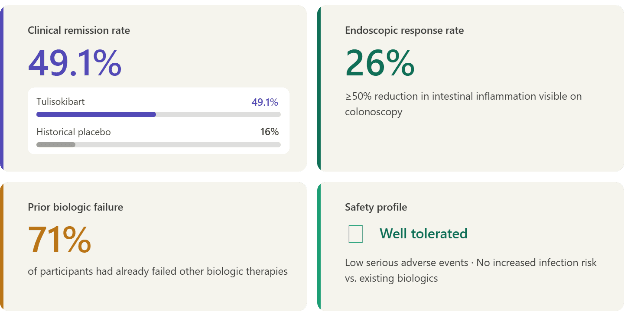
If you have been diagnosed with Crohn's disease, particularly moderate to severe disease, Covenant Metabolic Specialists may be able to offer you access to one of the most promising therapies in the IBD pipeline. We are currently enrolling patients in a Phase 3 clinical trial evaluating Tulisokibart (MK-7240), an investigational medication developed by Merck that works by targeting a novel immune pathway called TL1A a mechanism unlike any Crohn's therapy currently available.
The Phase 2 APOLLO-CD trial, published in The Lancet Gastroenterology & Hepatology, produced results that turned heads across the gastroenterology community.
If you or someone you know has Crohn's disease and has struggled to find a medication that works for you, we encourage you to reach out to our team to find out if you may be eligible for treatment.
Covenant Metabolic Specialists has locations across Southwest Florida in Sarasota, Fort Myers, and Riverview. Visit us at mycms.health to learn more or to inquire about enrollment.
Frequently Asked Questions
Q1: What is the difference between Crohn’s disease and ulcerative colitis?
Both are forms of inflammatory bowel disease (IBD), but there are a few key differences. Crohn’s disease can affect any part of the GI tract from the mouth to the anus, and its inflammation penetrates all layers of the bowel wall. Ulcerative colitis is confined to the colon and rectum, and its inflammation stays in the innermost lining only. This difference in depth is what drives the different complications, treatment approaches, and surgical outcomes between the two conditions.
Q2: Is IBD the same thing as IBS?
IBD and IBS are not the same thing. IBD (inflammatory bowel disease) causes real, measurable damage to the GI tract that can be confirmed on a colonoscopy or biopsy. IBS (irritable bowel syndrome) produces similar symptoms but does not produce any structural damage to the GI tract.
Q3: Can Crohn’s disease turn into ulcerative colitis, or vice versa?
No. Crohn’s disease and ulcerative colitis are distinct conditions and one does not convert into the other. However, in some cases of IBD, the findings are not conclusive enough. In this case, that a definitive diagnosis cannot be made. The diagnosis is then called indeterminate colitis or IBD-unclassified
Q4: Is there a cure for Crohn’s disease or ulcerative colitis?
There is currently no cure for Crohn’s disease. Surgery can remove diseased segments of bowel and manage complications, but because Crohn’s can affect the entire GI tract, the disease often recurs. Ulcerative colitis, however, can be effectively cured by surgically removing the entire colon. This is simply because the disease is confined to the colon.
References
Crohn's & Colitis Foundation. (n.d.). Ulcerative colitis vs. Crohn's disease: What are the early signs and how are they diagnosed? https://www.crohnscolitisfoundation.org/blog/ulcerative-colitis-vs-crohns-disease-what-are-the-early-signs-and-how-are-they-diagnosed
Feagan, B. G., Sands, B. E., Siegel, C. A., Peyrin-Biroulet, L., & Danese, S. (2025). Safety and efficacy of the anti-TL1A monoclonal antibody tulisokibart for Crohn's disease: A phase 2a induction trial. The Lancet Gastroenterology & Hepatology, 10(8), 715–725. https://doi.org/10.1016/S2468-1253(25)00071-8
Guedelha Sabino, J., Sands, B. E., Peyrin-Biroulet, L., Yen, M., Zhou, W., Dong, B., & Feagan, B. G. (2025). Infection adverse events with tulisokibart over 50 weeks of treatment in the phase 2 Crohn's disease APOLLO-CD trial. Journal of Crohn's and Colitis, 19(Supplement 1), i1445–i1446. https://doi.org/10.1093/ecco-jcc/jjae190.0923
Kucharzik, T., Ellul, P., Greuter, T., Rahier, J. F., Verstockt, B., Abreu, C., Albuquerque, A., Allocca, M., Esteve, M., & Farraye, F. A. (2021). ECCO guidelines on the prevention, diagnosis, and management of infections in inflammatory bowel disease. Journal of Crohn's and Colitis, 15(6), 879–913. https://doi.org/10.1093/ecco-jcc/jjab052
Lv, R., Qiao, W., Wu, Z., Wang, Y., Dai, S., Liu, Q., & Qian, S. (2023). Comparative study on the pathogenesis of Crohn's disease and ulcerative colitis. World Journal of Gastroenterology, 29(26). https://pmc.ncbi.nlm.nih.gov/articles/PMC12146918/
Mayo Clinic. (2024, March 18). Ulcerative colitis vs. Crohn's disease. https://www.mayoclinic.org/diseases-conditions/inflammatory-bowel-disease/in-depth/ulcerative-colitis-vs-crohns-disease/art-20590269
Merck & Co. (2024, October). Merck to present new long-term data for tulisokibart (MK-7240), an investigational anti-TL1A monoclonal antibody, in inflammatory bowel disease at UEG Week 2024. https://www.merck.com/news/merck-to-present-new-long-term-data-for-tulisokibart-mk-7240-an-investigational-anti-tl1a-monoclonal-antibody-in-inflammatory-bowel-disease-at-ueg-week-2024/
Mościcka, P., Markiewicz-Żukowska, R., & Gromkowska-Kępka, K. (2024). Crohn's disease and ulcerative colitis: From pathophysiology to novel therapeutic approaches. International Journal of Molecular Sciences, 25(6). https://pmc.ncbi.nlm.nih.gov/articles/PMC10967867/
National Institutes of Health, National Library of Medicine. (2023). Inflammatory bowel disease — StatPearls. https://www.ncbi.nlm.nih.gov/books/NBK470312/
National Institutes of Health, National Library of Medicine. (2025). Crohn disease — StatPearls. https://www.ncbi.nlm.nih.gov/books/NBK436021/
Roda, G., Chien Ng, S., Kotze, P. G., Argollo, M., Panaccione, R., Spinelli, A., Kaser, A., Peyrin-Biroulet, L., & Danese, S. (2020). Advancing therapeutic frontiers: A pipeline of novel drugs for luminal and perianal Crohn's disease management. Therapeutic Advances in Gastroenterology. https://pmc.ncbi.nlm.nih.gov/articles/PMC11660281/
Sands, B. E., Feagan, B. G., Peyrin-Biroulet, L., & colleagues. (2024). Phase 2 trial of anti-TL1A monoclonal antibody tulisokibart for ulcerative colitis. New England Journal of Medicine, 391, 1119–1129. https://doi.org/10.1056/NEJMoa2314076
Sexton, K., & Mahadevan, U. (2024, December). A study to evaluate the efficacy and safety of tulisokibart (MK-7240) in participants with moderate to severe Crohn's disease (MK-7240-008). ClinicalTrials.gov. https://clinicaltrials.gov/study/NCT06430801
Wehkamp, J., Götz, M., Herrlinger, K., Steurer, W., & Stange, E. F. (2016). Inflammatory bowel disease: Crohn's disease and ulcerative colitis. Deutsches Ärzteblatt International, 113(5), 72–82. https://pmc.ncbi.nlm.nih.gov/articles/PMC4782273/
Medical Advice Disclaimer
The content on CMS’s website (including, without limitation, any testimonials) is for general informational purposes only. It is not intended to diagnose or treat any condition, illness, or disease. All content from this site or connected social media channels is not intended to be used for medical diagnosis or treatment. Please consult a licensed medical professional for medical advice. CMS does not guarantee the accuracy, completeness, or timeliness of any information presented on this website.